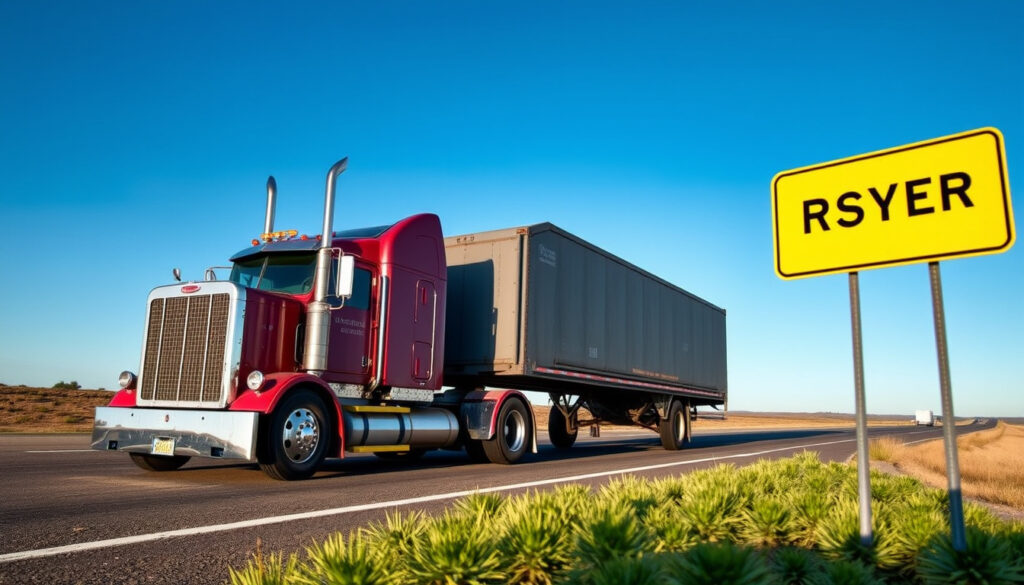
Why Is It Called a Semi-Truck? History & Key Terms
Almost everyone has seen a semi-truck rumbling down the highway, but few know why it’s called “semi” — the answer isn’t about the truck itself but the trailer, which lacks front wheels and relies on the tractor for support. We’ll untangle the name, explore regional terms like “lorry” and “18-wheeler,” and trace the history that made these rigs the backbone of freight transport.
Wheels on a typical semi-truck: 18 ·
Maximum gross vehicle weight (US): 80,000 lbs (36,287 kg) ·
Average trailer length: 53 ft (16 m) ·
First semi-trailer invention year: 1914 ·
Common fuel efficiency: 6–8 mpg
Quick snapshot
- The “semi” refers to the semi-trailer, not the tractor unit (Schneider Jobs (trucking industry blog))
- Maximum US weight limit is 80,000 lbs (Wikipedia (community encyclopedia))
- Exact origin of the word “lorry” is uncertain
- Whether “semi-truck” or “18-wheeler” is more common in certain regions
- The exact year of the first semi-trailer invention is uncertain (some sources say 1898, others 1899)
- Whether Alexander Winton’s or August Fruehauf’s design is more influential is debated
- 1898/1899: First semi-trailer invented by Alexander Winton (Iowa State University (academic research))
- 1914: August Fruehauf’s semi-trailer design commercialized (Iowa State University (academic research))
- 1920s–1950s: Semi-trailer trucks replace traction engines in haulage (Wikipedia (community encyclopedia))
- Electric semi-trucks (e.g., Tesla Semi) promise 500+ mile range (Wikipedia (community encyclopedia))
- Natural gas and hydrogen fuel cell alternatives are emerging (Wikipedia (community encyclopedia))
Seven key facts at a glance: the semi-truck’s dimensions and naming conventions reveal its engineering purpose.
| Label | Value |
|---|---|
| Full name | Semi-trailer truck |
| Common nickname | 18-wheeler |
| Number of wheels | 18 (10 on tractor, 8 on trailer) |
| Maximum gross vehicle weight (US) | 80,000 lbs (36,287 kg) |
| Typical trailer length | 53 ft (16 m) |
| Fuel types | Diesel, electric, natural gas |
| Primary use | Long-haul freight transport |
Why do they call it a semi-truck?
- The “semi” refers to the semi-trailer, not the truck itself (Schneider Jobs (trucking industry blog))
- A semi-trailer is a trailer without a front axle (Wikipedia (community encyclopedia))
- The full term is “semi-trailer truck”
The role of the semi-trailer
The key is in the prefix “semi-,” meaning “partially.” A semi-trailer carries its own weight only at the rear; its front rests on the tractor unit via a fifth-wheel coupling. This design makes the whole combination more maneuverable than a rigid truck of the same length. As Arnold & Itkin LLP (trucking injury law firm) explains, the trailer is “partially supported by its own wheels and partly by the tractor.” That partial support is the reason for “semi.”
How the name evolved over time
Early automobiles needed a way to transport multiple vehicles without building a massive single chassis. Alexander Winton, a Cleveland carmaker, invented the first semi-trailer in the late 1890s so his company could haul cars to customers (Iowa State University (academic research)). By 1914, August Fruehauf had improved the design and founded the Fruehauf Trailer Company. The term “semi-truck” was a natural shorthand for “semi-trailer truck” — a name that stuck.
The implication: the name itself encodes the core engineering trade-off that makes these trucks both efficient and maneuverable.
What is a semi-truck?
- A semi-truck consists of a tractor unit and a semi-trailer (Wikipedia (community encyclopedia))
- The trailer is partially supported by the tractor
- Maximum US weight limit is 80,000 lbs
Tractor unit vs. trailer
The tractor (the cab) contains the engine and driver compartment. It connects to the trailer via a fifth-wheel hitch — a circular plate that allows the trailer to pivot. Unlike a rigid truck where the cargo box is fixed to the chassis, a semi-trailer can be swapped quickly, enabling one tractor to haul multiple loads in a day (Buske Logistics (logistics company)).
Common configurations
Semi-trucks come in many configurations: day cabs (no sleeper), sleeper cabs (for long-haul), and specialized models like tankers, reefers (refrigerated), and flatbeds. The number of axles varies too — a typical 18-wheeler has three axles on the tractor (one steering, two drive) and two axles on the trailer, each with dual tires.
Weight and size limits
In the United States, the maximum gross vehicle weight (GVWR) is 80,000 lbs (36,287 kg). The standard trailer length is 53 ft (16 m), though shorter trailers (40 ft, 48 ft) are also common. These limits are set by federal law to protect road surfaces and bridges.
Trucking fleets must balance payload against fuel costs: a fully loaded 53-ft semi can carry about 45,000 lbs of cargo, but every extra pound reduces fuel efficiency below the 6–8 mpg average.
The pattern: weight and dimension limits directly shape operational decisions, from route planning to tire replacement schedules.
What do the British call semi-trucks?
- British English uses “lorry” for trucks in general (Buske Logistics (logistics company))
- A semi-truck is an “articulated lorry”
- The word “lorry” may originate from the British dialect verb “lurry” (to pull or drag) (Teleroute (logistics glossary))
The term “lorry”
In the UK, Ireland, and many Commonwealth countries, “lorry” is the everyday word for any motor truck. An “articulated lorry” refers specifically to a tractor unit with a detachable trailer, connected by a coupling that allows the vehicle to bend in the middle — the same as a North American semi-truck.
Articulated lorry vs. rigid lorry
A “rigid lorry” has the cargo body fixed to the same chassis as the cab, like a straight truck. This distinction matters for licensing: in the UK, driving an articulated lorry often requires a separate license endorsement beyond a rigid lorry license.
Usage in Ireland and other Commonwealth countries
Ireland uses “lorry” too, but local slang sometimes shortens it to “lorry” or “truck.” In Canada and Australia, “semi-trailer” or “semi” is more common, though “articulated lorry” appears in formal documents.
If you are a US driver crossing into Canada, your “semi” is still a semi. But if you are a UK driver heading to continental Europe, watch for “Lkw” (Germany) or “camion” (France) — terminology shifts fast at borders.
The catch: regional terminology isn’t just a linguistic curiosity; it can affect legal compliance and driver training requirements.
What is an 18-wheeler semi-truck?
- An 18-wheeler has 10 wheels on the tractor and 8 on the trailer (Shopmonkey (automotive blog))
- The term is used interchangeably with “semi-truck” in the US
- Not all semi-trucks have 18 wheels — some have fewer axles
Why 18 wheels?
The “18-wheeler” nickname comes from the most common wheel configuration: a three-axle tractor (steering axle with two wheels, two drive axles each with four dual wheels) and a two-axle trailer (each axle has four dual wheels). That adds up to 2 + (4+4) + (4+4) = 18 wheels. But as Great Western Transportation (trucking history resource) notes, some tractors have only two axles, giving a total of 14 or 16 wheels.
Variations: 10-wheeler, 16-wheeler
Short haul semi-trucks often use a single drive axle (4 wheels) and a single trailer axle (4 wheels) for a total of 10 wheels. Heavier haulers may add a third trailer axle (lift axle) for 22 or even 26 wheels when fully loaded.
Relationship to the semi-truck
“18-wheeler” and “semi-truck” are effectively synonyms in everyday US speech, though “semi-truck” is the more precise engineering term. The public tends to use them interchangeably.
Just because it’s called an 18-wheeler doesn’t mean all semi-trucks have 18 tires. If a driver inspects before a load, they might find 14, 16, or 22 — and that affects braking and tire replacement costs.
What this means: the popular nickname is a convenient shorthand, but a driver’s pre-trip inspection must account for the actual configuration.
What is another name for a semi-truck?
- Common US synonyms: tractor-trailer, big rig, semi (Wikipedia (community encyclopedia))
- Regional variations exist (e.g., “lorry” in the UK)
- Slang terms evolved from different trucking eras
Tractor-trailer
“Tractor-trailer” is the second most common name in North America, emphasizing the two-part nature: a tractor that pulls a trailer. It’s often used in legal documents and industry publications.
Big rig
“Big rig” is an informal term popularized in the 1970s CB radio culture. It evokes the large size and power of these trucks compared to passenger cars.
Semi
The simplest shorthand: “semi.” Used conversationally: “I saw a semi jackknifed on I-80.” This abbreviation is universal across English-speaking regions.
18-wheeler
Already covered above — common in everyday language, especially in music and movies.
Lorry (UK)
As discussed, “lorry” dominates in the British Isles. In Ireland, you might hear “lorry” and sometimes “truck” influenced by American media.
The pattern: each name highlights a different feature — the trailer (semi-trailer), the wheel count (18-wheeler), the articulation (articulated lorry), or the size (big rig).
Six terms for the same machine, one pattern: each name highlights a different feature — the trailer (semi-trailer), the wheel count (18-wheeler), the articulation (articulated lorry), or the size (big rig).
| Feature | Semi-truck (US) | Articulated lorry (UK) | Rigid lorry (UK) |
|---|---|---|---|
| Articulation | Yes (fifth-wheel coupling) | Yes (turntable coupling) | No (fixed chassis) |
| Number of wheels (typical) | 18 | 18 | 6–10 |
| Typical length | 53 ft (16 m) | 16.5 m (approx) | 8–12 m |
| Primary use | Long-haul freight | Long-haul freight | Local deliveries, construction |
Confirmed facts
- The term “semi” refers to the semi-trailer (Schneider)
- Maximum US weight 80,000 lbs (Wikipedia)
- British term “lorry” is used for trucks (Buske Logistics)
What’s unclear
- Exact origin of the word “lorry” is uncertain
- Whether “semi-truck” or “18-wheeler” is more common in certain regions
- The exact year of the first semi-trailer invention is uncertain (some sources say 1898, others 1899)
- Whether Alexander Winton’s or August Fruehauf’s design is more influential is debated
“The ‘semi’ in semi-truck refers to the semi-trailer, not the tractor unit. Semi-trailers have no front axle and are designed so that a portion of their weight is supported by the tractor.”
— Schneider Jobs (trucking industry blog)
“A semi-trailer truck is a combination vehicle made of a tractor unit and one or more semi-trailers to carry freight.”
— Wikipedia (community encyclopedia)
“The first semi-trailer truck was invented by Alexander Winton in the late 1890s so he could transport his automobiles.”
— Iowa State University Institute for Transportation (academic research)
For anyone involved in freight, the naming confusion is more than trivia: it affects licensing, insurance, and even vehicle registration. A US driver who hears “articulated lorry” might not realize they need an additional endorsement. The distinction between “semi” and “rigid” is built into traffic laws on both sides of the Atlantic. If you’re hauling across borders, knowing exactly what you’re driving — and what local officials call it — can save you from fines or worse. For the North American trucking industry, the bottom line is clear: call it a semi-truck to be understood from Canada to Mexico, but learn the local term when heading overseas, or risk a miscommunication that could cost a contract.
gwtrans.com, dhl-freight-connections.com, driverresourcecenter.com, zanerhardenlaw.com, en.wikipedia.org
Frequently asked questions
What is the difference between a semi-truck and a full truck?
A “full truck” usually refers to a rigid truck where the cargo body is permanently attached to the chassis. A semi-truck has a detachable trailer supported partly by the tractor.
Why are semi-trucks called 18-wheelers?
Because the most common configuration has 10 wheels on the tractor (steering + two dual drive axles) and 8 wheels on the trailer (two dual axles).
Can a semi-truck drive without a trailer?
Yes, the tractor can be driven without a trailer, but special precautions are needed because the rear of the tractor is unbalanced and can be unstable.
How much does a new semi-truck cost?
A new semi-truck tractor typically costs between $150,000 and $200,000, with sleeper cabs and premium brands like Peterbilt often at the higher end.
What is the Tesla Semi?
The Tesla Semi is a fully electric semi-truck with a claimed 500-mile range. Production began in 2022, and as of 2025, pilots with major fleets are underway.
How long does a semi-truck last?
With proper maintenance, a semi-truck can last 500,000 to 1,000,000 miles, roughly 10 to 20 years of service.
What is the top speed of a semi-truck?
Most semi-trucks are governed at 65–75 mph for fuel efficiency and safety, but many have the capability to go faster.
Related reading
More related posts
 Saint Patrick: History, Myths, and Legacy of Ireland’s Patron
 Team USA Olympics Hockey Roster – 2026 Full Breakdown
 Hims and Hers Stock – Price Performance and Outlook
 Daddy Yankee Now: Retirement, Divorce & Return 2025
 Super Mario Galaxy Movie: Release Date, Cast, LGBTQ Character
 Alexis Bledel: Biography, Age, Husband, and Career Update
 Equifax Free Credit Report – Instant Access Guide Canada
 Jon Bon Jovi: Health, Wife, Faith & Net Worth Facts 2024