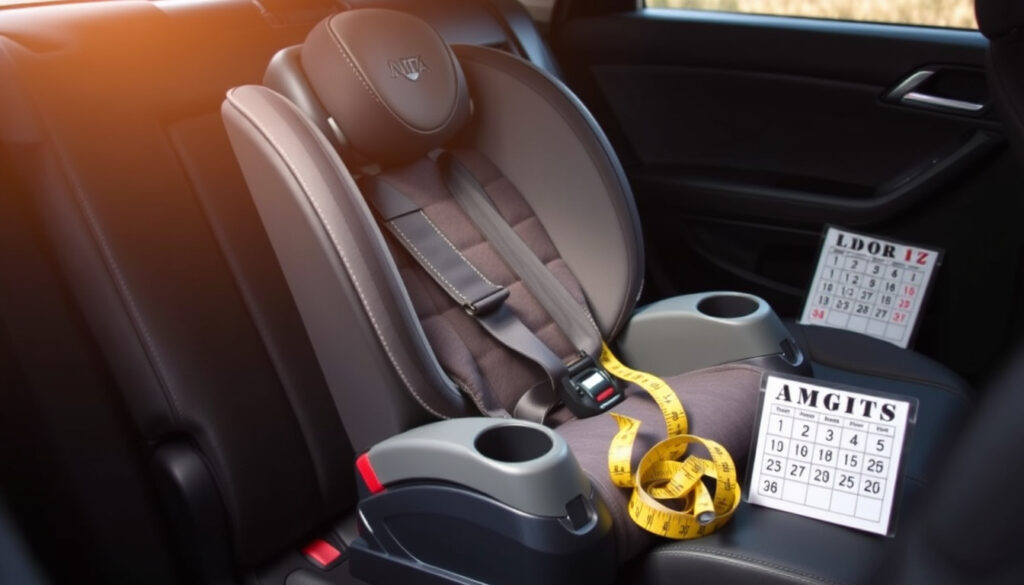
Booster Seat Age Guide: When to Switch & Safety Laws
Figuring out when your child is ready for a booster seat—and when they can finally ditch it—is one of those parenting puzzles that keeps getting harder, not easier. Laws vary by state and country, car seat manufacturers update guidelines, and well-meaning advice from friends and family often contradicts what the experts say.
Minimum weight for booster seat (most guidelines): 40 lbs (18 kg) ·
Minimum height for booster seat (most guidelines): 38 inches (97 cm) ·
Irish law: child must use booster until 150 cm (59 inches) or 36 kg (79 lbs) ·
UK law: child must use booster until 135 cm (53 inches) or 12 years old ·
NHTSA recommendation for booster seat readiness: At least 4’9″ (145 cm) and 8-12 years old
Quick snapshot
- Irish law: child under 150 cm or 36 kg must use booster seat (RSA (Irish Road Safety Authority))
- UK law: child under 135 cm or 12 years must use booster seat (UK Government guidance)
- NHTSA recommends booster until at least 4’9″ tall and 8-12 years (NHTSA (US safety regulator))
- Whether a 3-year-old weighing 40 lbs can safely use a booster seat is debated; most experts advise waiting until age 4 (AAP (American Academy of Pediatrics))
- Effectiveness of backless vs high-back in side-impact crashes is not fully quantified by independent tests (The Car Seat Lady (child passenger safety educator))
- 2006 – EU Directive introduces ECE R44 regulations for child seats (RSA (Irish Road Safety Authority))
- 2018 – Ireland updates law: booster seat required until 150 cm or 36 kg (RSA (Irish Road Safety Authority))
- 2019 – UK enforces stricter rules: children under 135 cm must use booster (UK Government guidance)
- Child graduates to seat belt alone only after passing the 5-step fit test (NHTSA (US safety regulator))
- Backless booster use is increasing, but safety experts urge high-back for younger children (CDC (US public health agency))
Five key facts about booster seat requirements highlight how quickly rules change by region and by child size:
| Fact | Value |
|---|---|
| Minimum weight for booster seat | 40 lbs (18 kg) |
| Minimum height for booster seat | 38 inches (97 cm) |
| Ireland: legal booster requirement ends at | 150 cm (59 inches) or 36 kg (79 lbs) |
| UK: legal booster requirement ends at | 135 cm (53 inches) or 12 years old |
| NHTSA: typical booster seat graduation | Age 8-12, height 4’9″ (145 cm) |
At what age can I use a child’s booster seat?
What is the minimum weight for a booster seat?
- Most booster seats on the US market require a minimum child weight of 40 pounds (Tennessee Traffic Safety Resource Service (state safety authority)).
- In Indiana, guidance says children at least 40 pounds may use a booster seat, but troopers encourage keeping children in a forward-facing harness until at least 65 pounds (Indiana State Police (law enforcement)).
- The American Academy of Pediatrics states that children whose weight or height exceeds the forward-facing limit should use a belt-positioning booster seat (AAP (leading pediatric medical organization)).
What is the minimum height for a booster seat?
- In many US states, including Georgia, a child must be at least 4’9″ before they can legally stop using a booster (Georgia Governor’s Office of Highway Safety (state agency)).
- Ohio booster-seat minimum use guidance says a child should be at least 4 years old, weigh at least 40 pounds, have outgrown the forward-facing seat, and be able to sit still (Nationwide Children’s Hospital (pediatric hospital)).
- European regulations (ECE R44) place Group 2/3 booster seats at 15–36 kg, but height is the more reliable indicator (RoSPA (UK safety charity)).
Age is the most common question, but height and weight are the actual legal triggers. A 4-year-old who meets 40 lbs and 38 inches may use a booster in many jurisdictions, but safety groups urge keeping kids in harness seats longer because muscle development and behaviour matter just as much.
Does a 7 year old need a booster seat in Ireland?
What are the Irish booster seat laws?
Irish law requires children under 150 cm (59 inches) or 36 kg (79 lbs) to use a booster seat (RSA (Irish Road Safety Authority)). A 7-year-old who hasn’t reached that height or weight must still be in a booster. Backless booster seats are only legal for children over 125 cm and 22 kg, provided the vehicle has a head restraint. The RSA offers a free Check it Fits service to verify correct installation.
What is the RSA recommendation for booster seats?
- Children should use a high-backed booster until they exceed 125 cm or the seat’s limit (RSA (Irish Road Safety Authority)).
- Once a child reaches 150 cm or 36 kg, they may use an adult seat belt, but the RSA recommends continuing the five-step fit check (Tusla (Irish child and family agency)).
Irish parents face a split: the law sets a high upper limit (150 cm), but the backless booster rules introduce a lower intermediate threshold (125 cm). Many 7-year-olds are between those lines, meaning a high-back booster is still the safest choice—and often the only legal one if the car lacks a head restraint.
Can my 7 year old use a backless booster seat?
Is a backless booster safe for a 7-year-old?
Backless boosters are safe only if the vehicle seat has a head restraint and the child passes the five-step seat belt fit test (The Car Seat Lady (child passenger safety educator)). Typical backless boosters require a minimum child height of 125 cm (49 inches) and weight of 22 kg (UK Government guidance). High-back boosters provide better side impact protection because the shell and head wings absorb crash forces.
What are the requirements for backless booster seats?
- The vehicle must have an adjustable head restraint that can be positioned behind the child’s head (RSA (Irish Road Safety Authority)).
- The child’s ears must be below the top of the head restraint or seat back.
- The lap belt must lie low across the hips, not the stomach.
Two types of booster seats, one clear pattern: high-back boosters sacrifice portability for structure, while backless boosters trade protection for convenience.
| Feature | High-back booster | Backless booster |
|---|---|---|
| Side impact protection | Built-in head and torso wings | None (relies on vehicle head restraint) |
| Minimum height requirement | Typically 97 cm (38 in) | Typically 125 cm (49 in) |
| Portability | Heavy, less portable | Light, easy to move between cars |
| Head restraint required in car | No (seat provides its own) | Yes |
| Price range | $60–$200 | $20–$50 |
The implication: For a 7-year-old who still fits in a high-back, the added side-impact protection is a measurable safety advantage that no price tag fully captures.
Can a 4 year old use a booster seat in the UK?
What is the UK law for car seats for 4-year-olds?
In the UK, children must use a car seat until they are 135 cm tall or 12 years old, whichever comes first (UK Government guidance). A 4-year-old must use a high-backed booster seat with a backrest—backless boosters are not recommended for children under 125 cm (RoSPA (UK safety charity)).
Can a 4-year-old use a backless booster in the UK?
- No. UK law effectively bans backless boosters for children under 125 cm (UK Government guidance).
- The AA recommends using a high-backed booster until the child reaches 135 cm regardless of age (AA (UK motoring organisation)).
- A 4-year-old is almost always below 125 cm, so a high-back booster is the only legal and safe option.
UK parents who buy a backless booster for a 4-year-old are not just choosing a less protective seat—they are breaking the law. The 125 cm threshold is a hard floor, not a suggestion.
What are signs my child is ready without a booster?
How to perform the 5-step seat belt fit test
The Car Seat Lady’s five-step test is the gold standard for knowing when a child can safely use an adult seat belt (The Car Seat Lady (child passenger safety educator)):
- The child’s knees bend at the edge of the seat while their back is flat against the vehicle seat.
- The lap belt lies low across the hips, touching the thighs, not the stomach.
- The shoulder belt crosses the middle of the collarbone and chest, not the neck or face.
- The child can sit without slouching for the entire trip.
- The child’s feet rest flat on the floor (not dangling).
What height and weight indicate readiness?
- The NHTSA says children should stay in a booster seat until they are big enough to fit properly in a seat belt, typically at least 4’9″ tall and between 8 and 12 years old (NHTSA (US safety regulator)).
- The CDC echoes that children who outgrow their forward-facing car seat should use a booster in the back seat until the seat belt fits properly (CDC (US public health agency)).
- Every child is different—height is a better indicator than weight alone for proper belt fit.
Upsides
- Booster seats significantly reduce injury risk for children who are too small for adult seat belts
- High-back boosters provide better side-impact protection and built-in head support
- Backless boosters are affordable and easy to move between cars—great for carpools or taxis
- Many states and countries have clear laws, making compliance straightforward
Downsides
- Backless boosters lack side-impact protection and require a vehicle head restraint
- The minimum age of 4 is a floor, not a target—many children are not developmentally ready at 4
- Laws vary by jurisdiction, leading to confusion for families who travel or move across borders
- Booster seats expire (typically 6 years from manufacture), adding cost and waste
Key steps for using a booster seat safely
- Always use the booster in the back seat—never the front.
- Secure the booster using the vehicle’s seat belt or LATCH system (follow manufacturer instructions).
- Ensure the seat belt lies flat and tight; no twisting or slack.
- Check that the child does not place the shoulder belt under their arm or behind their back.
- Replace the booster after any moderate or severe crash (NHTSA (US safety regulator)).
Confirmed facts
- Irish law: child under 150 cm or 36 kg must use booster seat (RSA (Irish Road Safety Authority))
- UK law: child under 135 cm or 12 years must use booster seat (UK Government guidance)
- NHTSA recommends booster until at least 4’9″ tall and 8-12 years (NHTSA (US safety regulator))
- Backless boosters not recommended for children under 125 cm (UK Government guidance)
What’s unclear
- Whether a 3-year-old weighing 40 lbs can safely use a booster seat – most experts advise waiting until age 4 (AAP (American Academy of Pediatrics))
- Effectiveness of backless vs high-back in side-impact crashes is not fully quantified by independent tests (The Car Seat Lady (child passenger safety educator))
Expert perspectives on booster seat safety
“Children should stay in a booster seat until they are big enough to fit in a seat belt properly.”
— NHTSA (US safety regulator)
“The safest option for any child who needs a booster is a high-backed booster with a five-point harness until they reach the upper weight limit.”
— RSA (Irish Road Safety Authority)
“Children must use a car seat until they are 135 cm tall or 12 years old, whichever comes first.”
— UK Government guidance
“If the child is slouching, if the lap belt is riding up onto the stomach, if the shoulder belt is touching the neck or face, the child is not ready to leave the booster.”
— The Car Seat Lady (child passenger safety educator)
The reality check: Even the most advanced booster seat can’t compensate for a child who isn’t developmentally ready to sit still for an entire drive. For parents in Ireland and the UK, the legal thresholds are clear, but the emotional decision to move a child out of a booster is tougher. The trade-off is simple: high-back for younger or smaller children, backless only when the child passes the five-step test and the car has the right head restraint. For parents across the US, state-by-state variation means checking local laws and the NHTSA’s guidance remains the safest bet.
Related reading: Bridget Moynahan: Age, Children, Relationship with Tom Brady & More · Natalie Portman: Kids, Religion, Separation & Latest News
iridesafe.com, buckleupmn.org, ghsa.org, tiptonfordbrownsville.com
For a detailed breakdown of the legal requirements specific to Ireland, see Irish booster seat laws, which outlines the age and safety rules for 2025.
Frequently asked questions
Can a 5-year-old use a booster seat?
Yes, if the child weighs at least 40 lbs and is at least 38 inches tall. Many 5-year-olds meet these requirements. However, the CDC (US public health agency) recommends using a forward-facing harness seat as long as the child falls within the seat’s weight and height limits, because harness seats provide better protection.
Do booster seats expire?
Yes. Most booster seats expire 6 years from the date of manufacture. Expiration dates are stamped on the seat shell. The plastic can degrade over time, especially in hot climates, reducing protection in a crash (NHTSA (US safety regulator)).
Can I use a booster seat in the middle seat of a car?
Only if the middle seat has a lap-and-shoulder belt (not just a lap belt). Most booster seats require a three-point belt. Check the vehicle owner’s manual and booster seat instructions (Safe Ride News (child passenger safety resource)).
Is it safe to use a second-hand booster seat?
Only if you know its full history—whether it has been in a crash, whether it is expired, and whether all parts including the instruction manual are present. NHTSA (US safety regulator) advises against using second-hand seats when the history is unknown.
What is the difference between a booster cushion and a high-back booster?
A booster cushion is a backless seat that raises the child to improve seat belt fit. A high-back booster includes a backrest with side wings and a head restraint, offering better side-impact protection and a more comfortable sleeping position for children (The Car Seat Lady (child passenger safety educator)).
How do I know if my child is too tall for a booster seat?
Check the booster seat’s height limit, usually indicated where the child’s ears reach the top of the seat back or head wings. In a high-back booster, if the child’s eyes are above the top of the seat, it’s time to transition (RSA (Irish Road Safety Authority)).
Are backless booster seats illegal in some states?
No US state outright bans backless boosters, but several states require a booster that meets federal safety standards. For example, California requires children under 8 and under 4’9″ to be in a car seat or booster (California Highway Patrol (state law enforcement)). The form factor (backless vs high-back) is not banned.
Should a 7-year-old use a booster seat on a plane?
The FAA recommends children under 40 lbs use a car seat on airplanes, but booster seats are generally not approved for aircraft because they don’t have a harness. A 7-year-old who meets the weight threshold should use the aircraft seat belt. Check the specific booster seat’s approval for air travel (NHTSA (US safety regulator)).
More related posts
 Meadow Walker: Wedding, Lawsuit, and Vin Diesel Bond
 Colin Mochrie: Emergency Surgery & Recovery Update
 How to Recycle Electronics Free in Ireland
 David Laid: Biography, Height, Age, and Scoliosis Facts
 Altered Carbon Season 3: Canceled Status, Revival Hopes
 Is Pineapple Good for Dogs? Benefits, Risks & Safe Feeding
 Ted Lasso Season 4: Premiere Date, Cast Changes & Trailer
 French President Macron: Wife, Age Gap, and Biography