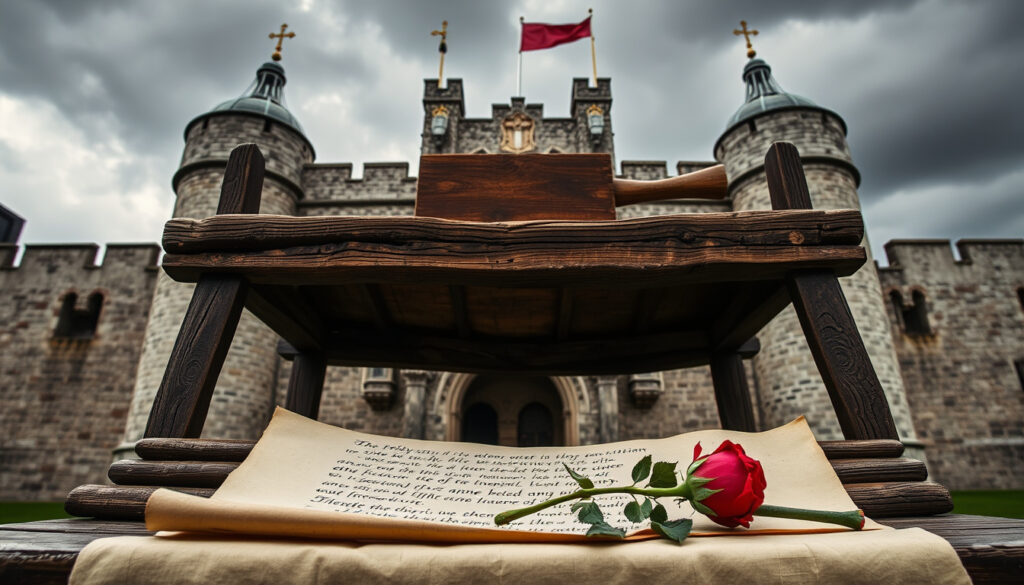
Anne Boleyn: Why Henry Executed Her and What She Said
When a queen loses her head, the questions don’t stop—they multiply. Five centuries after Anne Boleyn walked onto Tower Green, the same curiosities still surface: why Henry VIII turned on her, what she said at the end, and where her remains actually rest. This guide cuts through centuries of speculation to answer the most searched questions about the Tudor queen, using verified records from the institutions that keep her story alive.
Born circa: 1501–1507 ·
Executed: 19 May 1536 ·
Queen consort: 1533–1536 ·
Number of children: 1 (Elizabeth I) ·
Cause of death: Beheaded for treason
Quick snapshot
- Executed 19 May 1536 at the Tower of London (Historic Royal Palaces (royal palace authority))
- Convicted of treason, adultery, and incest (Origins (Ohio State University))
- Only surviving child was Elizabeth I (Historic Royal Palaces)
- Buried at Chapel of St Peter ad Vincula (Historic Royal Palaces)
- Exact birth year (1501–1507) (EBSCO Research Starters (academic database))
- Whether she had a physical deformity (Wikipedia (general reference))
- True cause of her miscarriages (Hever Castle (historic estate))
- Authenticity of some reported final words (Wikipedia)
- 1533: Married Henry VIII and crowned queen (Hever Castle)
- 1536: Arrested, tried, executed in 17 days (The National Archives (UK government archive))
- Ongoing debate about her legacy as feminist icon vs. tragic victim (Historic Royal Palaces)
- DNA research may clarify burial location (Historic Royal Palaces)
Six key moments, one pattern: Anne Boleyn’s life moved from obscurity to power to the block in little more than a decade.
| Event | Date/Detail |
|---|---|
| Birth | Between 1501 and 1507 at Blickling Hall or Hever Castle (Hever Castle) |
| Marriage to Henry VIII | 25 January 1533 (secret ceremony) (Hever Castle) |
| Coronation | 1 June 1533 (Historic Royal Palaces) |
| Fall | Arrested 2 May 1536 (The National Archives) |
| Execution | 19 May 1536 at Tower Green (Origins (Ohio State University)) |
| Burial | Chapel of St Peter ad Vincula, Tower of London (Historic Royal Palaces) |
Why did Henry execute Anne?
What was the official charge against Anne Boleyn?
- Anne was convicted of treason, adultery, incest, and plotting the king’s death (Origins (Ohio State University)).
- Historic Royal Palaces notes that her execution came after only three years of marriage (Historic Royal Palaces (royal palace authority)).
What evidence did the prosecution use?
The trial was secretive and the evidence was likely fabricated, according to some historians. The National Archives holds state records documenting the preparations for her execution, including payments to the executioner (The National Archives (UK government archive)).
Did Anne Boleyn actually commit adultery?
Modern consensus says no. The charges were a political tool for Henry, who needed a male heir and wanted to marry Jane Seymour. The Tudor Blogger suggests the accusations were fabricated, though this is an interpretive reading (Tudor Blogger (Substack) – tier3/interpretive).
What did Anne Boleyn say before she died?
What were her exact last words?
“I come here to die, according to the law, and will not speak against it.”
– Anne Boleyn, as recorded in eyewitness accounts (Wikipedia (general reference))
Did she confess to any crimes?
She did not confess to treason or adultery. Her speech emphasized her acceptance of the legal process, not guilt. She prayed for the king and for her own soul.
How did she speak to the crowd at the Tower?
Eyewitness accounts report she spoke calmly and with composure, reflecting a dignified bearing even in the final moment (EBSCO Research Starters).
Anne’s execution speech was both a submission to the law and a quiet defiance—she didn’t plead for mercy or renounce her innocence.
Where is Anne Boleyn’s head?
Was her head buried separately from her body?
No separate burial for the head is recorded. Historic Royal Palaces confirms that her body and head were buried together at the Chapel of St Peter ad Vincula at the Tower of London (Historic Royal Palaces).
Is there a known grave for Anne Boleyn?
The exact location of the remains is not publicly marked. A plaque in the chapel commemorates her, but the remains lie under the chapel floor without a specific stone.
What happened to her body at the Tower of London?
After the beheading, her body was placed in an elm arrow chest and taken directly to the chapel for burial (Historic Royal Palaces).
The exact spot under the chapel floor remains unknown. Modern ground-penetrating radar could theoretically locate her, but no archaeological project has been authorized.
How many times did Anne Boleyn give birth?
Did she have any sons?
Anne gave birth to one surviving child: Elizabeth I. She had no surviving sons.
How many miscarriages did she suffer?
She had at least two recorded miscarriages, one in 1534 and another in 1535. Historic Royal Palaces notes these miscarriages weakened her position with Henry (Historic Royal Palaces).
What was the fate of her only daughter?
Elizabeth I became queen of England in 1558 and led one of the most successful reigns in English history (Historic Royal Palaces).
What disease did Anne Boleyn have?
Did she suffer from the sweating sickness?
Anne nearly died of the sweating sickness in 1528, a deadly viral disease that swept England (Hever Castle (historic estate)).
Was there a physical deformity?
No reliable evidence exists of a deformity or extra finger. The myth likely originated from Catholic propagandists after her death (Wikipedia (general reference)).
What modern diagnoses have been proposed?
Some modern historians suggest a possible genetic disorder such as polycystic ovary syndrome, but this remains unconfirmed and speculative (EBSCO Research Starters).
Is Kate Middleton a descendant of Anne Boleyn?
How is Kate Middleton related to the Tudor family?
Kate Middleton is a distant descendant through the Boleyn line, specifically via Mary Boleyn, Anne’s sister.
What is the direct line to Anne Boleyn?
The connection is not through Anne Boleyn herself—she had only one child, Elizabeth I, who had no children. The link goes through Mary Boleyn’s daughter, Catherine Carey (Hever Castle).
Is the connection through Mary Boleyn or Anne?
Genealogists trace Kate’s ancestry back to Mary Boleyn’s daughter. Mary was the mistress of Henry VIII before Anne, making the relationship complicated but well-documented.
It’s a common myth that Kate is descended from Anne herself. The actual line runs through the sister Henry slept with before Anne—making the dynastic irony complete.
How old was Anne Boleyn when she died?
Was she 29 or 35?
Most historians agree she was about 29–30 years old at execution. Her birth year is not precisely recorded (c.1501 or c.1507).
Why is her exact birthdate uncertain?
No parish records survive from her early years. The discrepancy comes from lack of early parish records (EBSCO Research Starters).
What is the most commonly accepted age?
EBSCO’s history summary says she was probably not yet 30 when she died (EBSCO Research Starters). That puts her death age at 29–30.
Timeline: Anne Boleyn’s life and execution
Nine dates, one story: from birth to the block in 35 years.
- : Anne Boleyn born (Hever Castle)
- : Returns to England from French court (Hever Castle)
- : Henry VIII begins pursuit of Anne (Hever Castle)
- : Marries Henry; crowned queen (Historic Royal Palaces)
- : Elizabeth I born (Historic Royal Palaces)
- : Miscarriages (Historic Royal Palaces)
- : Arrested at Greenwich (The National Archives)
- : Trial and conviction (Origins (Ohio State University))
- : Executed (Historic Royal Palaces)
What’s confirmed and what’s still unclear
Confirmed facts
- Anne Boleyn was executed on 19 May 1536 at the Tower of London (Historic Royal Palaces).
- She was found guilty of treason, adultery, and incest (Origins (Ohio State University)).
- Her only surviving child was Elizabeth I (Historic Royal Palaces).
- She was buried in the Chapel of St Peter ad Vincula (Historic Royal Palaces).
What’s unclear
- Her exact birth year (1501–1507) (EBSCO Research Starters).
- Whether she had a physical deformity (extra finger) (Wikipedia).
- The precise cause of her miscarriages (Hever Castle).
- The authenticity of some reported final words (Wikipedia).
- Whether she actually committed adultery with her brother (Origins (Ohio State University)).
Quotes that define the story
“I come here to die, according to the law, and will not speak against it.”
– Anne Boleyn, at her execution, 19 May 1536 (Wikipedia)
“He ordered her death after her conviction, but his exact words are not recorded.”
– The National Archives, on Henry VIII’s role in the execution (The National Archives)
For those studying Tudor history, the choice of perspective is clear: rely on primary sources held by the National Archives and Historic Royal Palaces, or risk repeating centuries-old propaganda. The real Anne Boleyn lies somewhere between the block and the myth.
englandcast.com, thefreelancehistorywriter.com, study.com, youtube.com, youtube.com
Related coverage: detailed account of her final moments fördjupar bilden av Anne Boleyn: Real Story, Execution, Children, Last Words & Facts.
Frequently asked questions
Why did Henry VIII marry Anne Boleyn?
Henry VIII married Anne Boleyn in 1533 because he was desperate for a male heir and had already been refused an annulment from Catherine of Aragon. Anne refused to become his mistress, which pushed him to break with the Catholic Church (Historic Royal Palaces).
What was Anne Boleyn’s relationship with her daughter Elizabeth?
Anne was separated from Elizabeth when the baby was just three months old, after Henry declared Elizabeth illegitimate. Anne never saw her daughter again before her execution (Historic Royal Palaces).
Did Anne Boleyn actually have an affair with her brother?
No credible evidence supports the charge of incest with her brother George Boleyn. The accusation was part of the fabricated case against her (Origins (Ohio State University)).
How many of Henry VIII’s wives were executed?
Two: Anne Boleyn (1536) and Catherine Howard (1542). Both were beheaded at the Tower of London (Historic Royal Palaces).
What was the sweating sickness that nearly killed Anne?
The sweating sickness was a mysterious and often fatal disease that swept England in the 16th century, characterized by sudden fever and sweats. Anne contracted it in 1528 but survived (Hever Castle).
Is there a portrait of Anne Boleyn?
Several portraits exist that are believed to depict Anne Boleyn, though none were painted from life. The most famous is the Nidd Hall portrait at the National Portrait Gallery (Historic Royal Palaces).
Where can I see Anne Boleyn’s execution site today?
The execution site at Tower Green is marked by a plaque and is part of the Tower of London, open to the public. The Chapel of St Peter ad Vincula is also accessible (Historic Royal Palaces (royal palace authority)).
More related posts
 Walton Goggins: Wife’s Death, Thailand Accident, and Loss
 Eagles vs Vikings Player Stats: Score, Betting & Key Takeaways
 How to Get Rid of Canker Sore Fa t: Cau e , Treatment & Relief
 Kumail Nanjiani Movies and TV Shows: The Full List
 Ottawa Police Service Names Release Criteria – Policy Factors Guide
 Nipsey Hussle’s Death: Facts, Last Words, and Legacy
 Steve-O: Jackass Star’s Sobriety, Health & Relationships
 Colin James: Biography, Songs, Tour Dates, Awards